Following the footsteps of Dr D Amen: qEEG Z-score power patterns and ADHD subtypes
Not all ADHD is created equal: Two individuals may both “struggle to focus,” yet:
- One brain is underactive and needs stimulation
- Another is overactive and needs calming
- Another is stuck and needs flexibility training
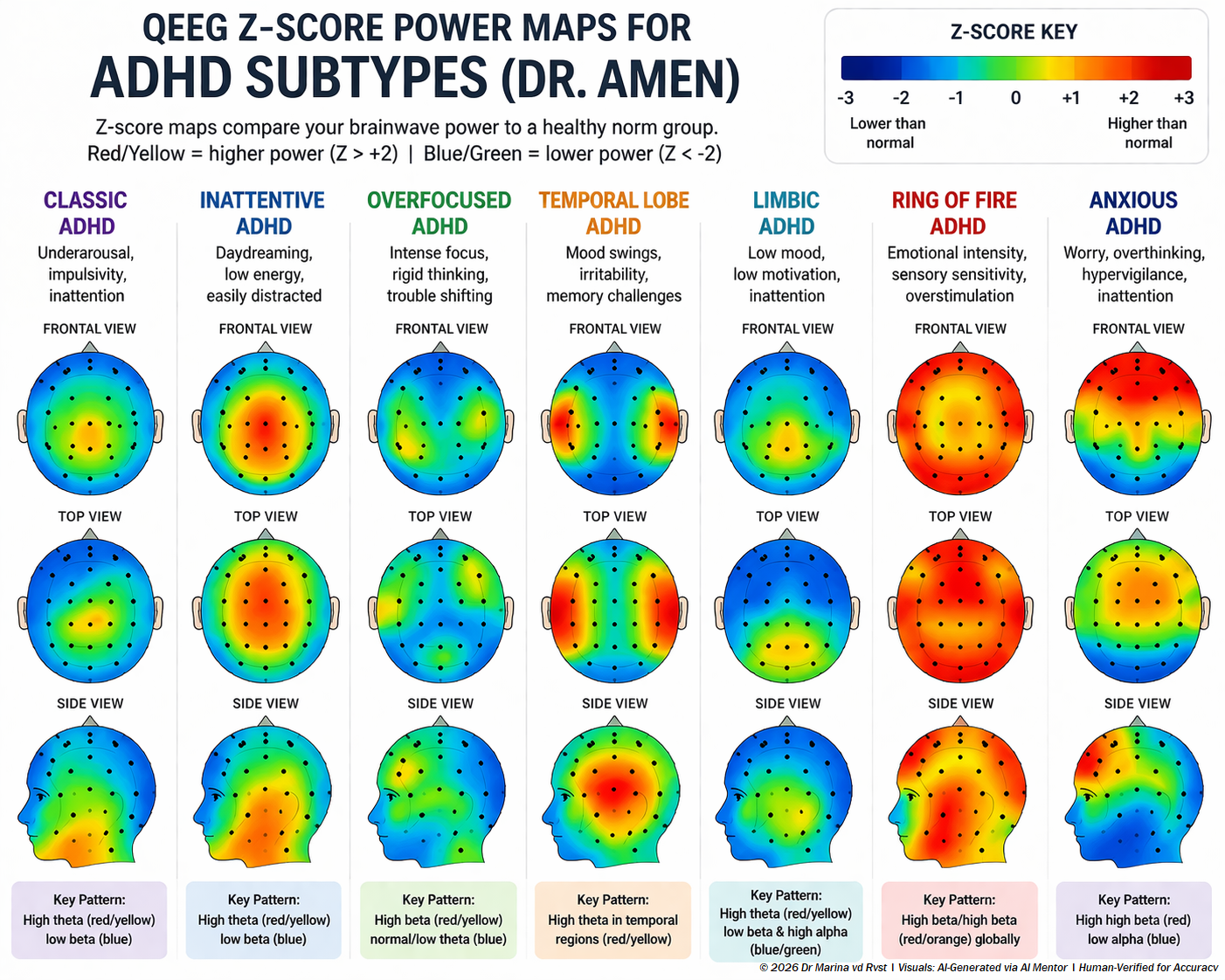
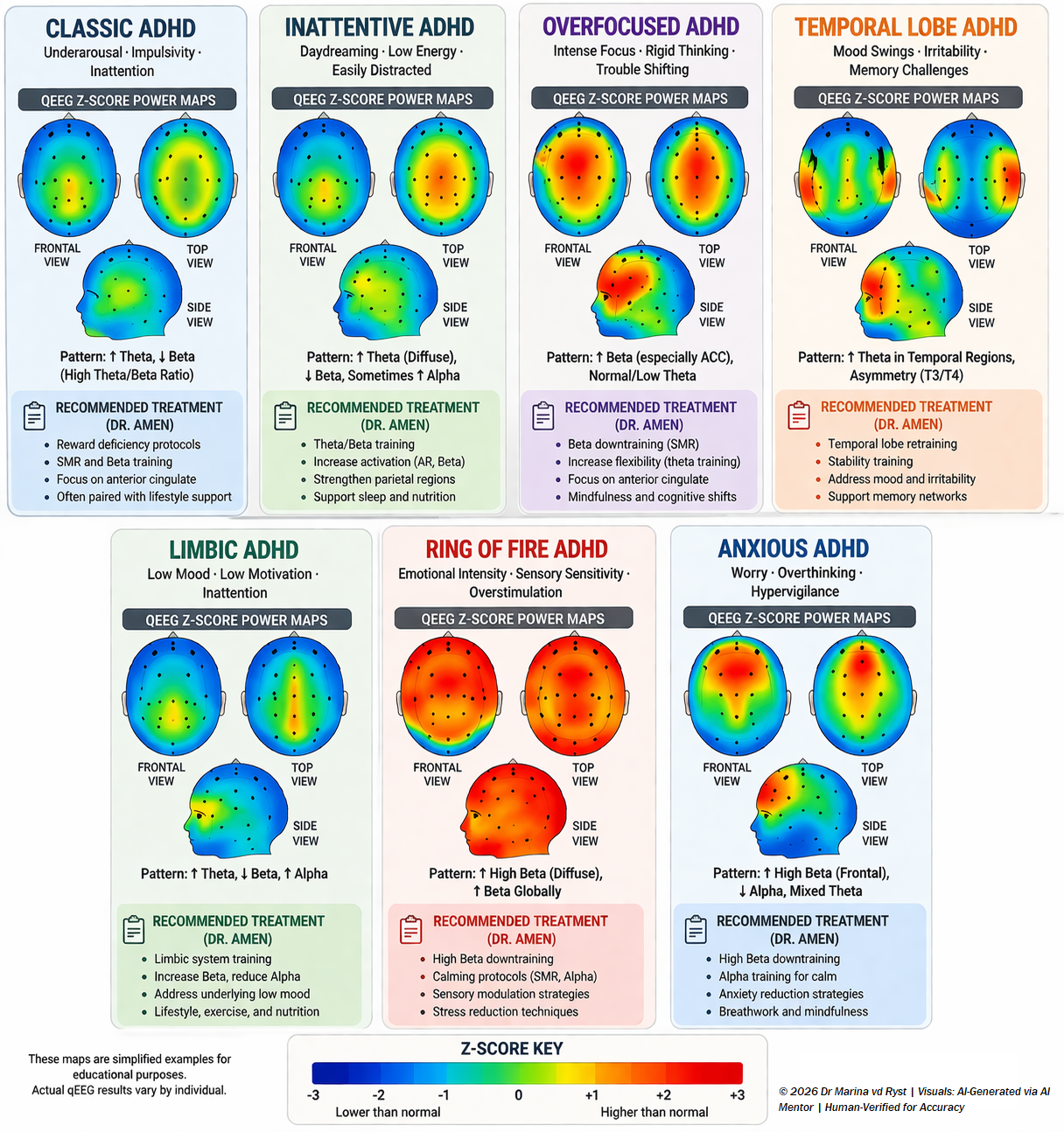
qEEG does not define the person—but it can clarify the pattern. Brain maps offer a visual representation of how different ADHD subtypes may present in the EEG of the brain. The path to focus, regulation, and change is not the same for everyone.
While traditional diagnostic systems (eg, DSM) rely on behavioural criteria, Neuroscience and research shown evidence of neurophysiological heterogeneity—the idea that ADHD reflects multiple underlying brain patterns rather than a single condition. Emerging evidence suggests that differentiated treatment, intervention and even medication is required for optimal management.
qEEG, particularly Z-score power analysis, provides a statistical comparison of an individual’s brain activity relative to normative databases, offering one lens through which these differences may be visualized. These patterns are:
- Generalized and educational – gain knowledge and insight
- Not diagnostic criteria – No label, but support to manage
- Not universally present in all individuals – your brain is unique
- They represent tendencies, not fixed truths.
The value lies not in labelling—but in understanding how a brain may operate—and how that understanding can open more precise and individual pathways for change and intervention
- Intervention strategies may differ (e.g., uptraining vs down training)
- Neurofeedback protocols are not one-size-fits-all
- Medication choices may be more individual-specific,
- Behavioural strategies can be better matched to underlying physiology and
- Differentiation can be made between anxiety and ADHD – important for school/work support
A PEEK UNDER THE HOOD: qEEG and Z-Score Power- Quick reference
- Z-score = deviation from the norm
- +2 or higher → excess activity
- −2 or lower → reduced activity
- Frequency bands:
- Delta (1–4 Hz) – deep rest
- Theta (4–8 Hz) – drowsy/inattentive
- Alpha (8–12 Hz) – relaxed wakefulness
- Beta (13–30 Hz) – active thinking/focus
- High Beta (22–30 Hz) – stress/hyperarousal
- Notice how some brains are underactive (cool colors), while others are overactive (warm colors).
SUB-TYPES
1. Classic ADHD: Under-arousal + inattention + impulsivity
QEEG Pattern:
- ↑ Theta (especially frontal midline, Cz/Fz)
- ↓ Beta (frontal regions)
- Elevated Theta/Beta ratio
Implication: A brain that is under-activated for the task demands, leading to drifting attention and stimulation-seeking behaviour.
2. Inattentive ADHD: Low energy, slow processing, internal distraction
QEEG Pattern:
- ↑ Theta (diffuse, often posterior + frontal)
- ↓ Beta (frontal and central)
- Sometimes ↑ Alpha (disengagement)
Implication: A “low activation” pattern—difficulty sustaining alertness rather than impulsivity
3. Overfocused ADHD: Cognitive rigidity, difficulty shifting attention
QEEG pattern:
- ↓ or normal Theta
- ↑ Beta (especially anterior cingulate / frontal midline)
- Possible ↑ High Beta
Implication: A brain that gets stuck—over-engaged in certain loops, making shifting attention difficult.
4. Temporal Lobe ADHD: Mood instability, irritability, learning variability
QEEG Patterns:
- Irregular activity in temporal regions (T3/T4)
- Spikes or ↑ Theta / slow activity in temporal lobes
- Possible asymmetries (left vs right)
Implication: Instability in temporal processing networks affecting memory, mood, and reactivity.
5. Limbic ADHD: Low mood + low motivation + inattention
QEEG Patterns:
- ↑ Theta (frontal)
- ↓ Beta
- ↑ Alpha (withdrawal/disengagement patterns)
Interpretation:
A “low mood + low activation” pattern—attention impacted by underlying affective tone.
6. Ring of Fire ADHD: Emotional reactivity, sensitivity, overstimulation
QEEG Patterns:
- ↑ High Beta (diffuse/global)
- ↑ Beta across multiple regions
- Possible reduced stability in alpha
Interpretation: Most difficult to treat, a globally overactive brain, easily overwhelmed by internal and external stimuli.
7. Anxious ADHD: Inattention driven by anxiety and hypervigilance
QEEG patterns:
- ↑ High Beta (especially frontal)
- ↓ Alpha (reduced calm states)
- Mixed Theta patterns
Interpretation: Often misdiagnosed. Attention is disrupted not by under arousal—but by overarousal and worry.
INTERVENTION :NEUROFEEDBACK
Neurofeedback enters into a different conversation with the brain—one that is not rooted in judgment, but in gentle awareness. Rather than asking, “What is wrong?” it begins with a quieter, more respectful question: What is your brain doing, and how can we support it? Within the frame of neurodivergence, patterns are not mistakes to be fixed, but expressions to be understood. Some brains run fast, some get stuck, some become overwhelmed, and others drift—each reflecting a unique way of processing the world. Neurofeedback invites you to observe these patterns in real time, and through that awareness, begin to guide them. Change does not come from force, but from learning, and repeating. In this training space, you are not judged or reduced to a label. You are met as a whole person, with a brain that can learn, adapt, and shift. And perhaps most importantly, you are not alone in that process. Your journey/conversation starts off with understanding ADHD subtypes through the QEEG (brain mapping) reflecting your unique patterns.